Species: Dogs & Cats7 dose protocols2 dosage forms
This page is a calculation and educational reference for veterinarians and veterinary students. It does not replace examination, culture and susceptibility testing, clinical judgment, or the attending veterinarian's final decision.
Reserve-drug dose calculation only: dog 20–30 mg/kg IV q8h; cat 10 mg/kg IV q12hSource: Papich & Martinez 2026 / Albarellos 2016
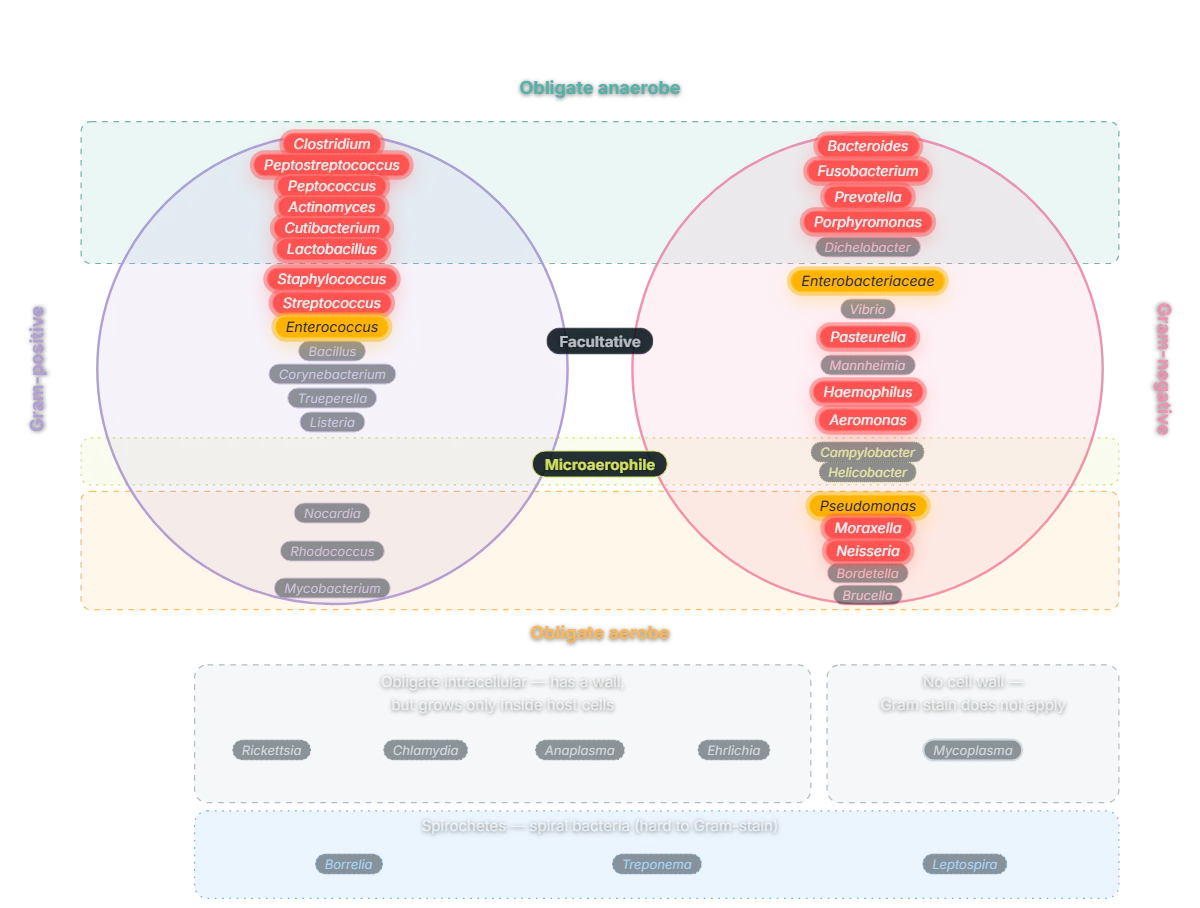
Spectrum of activity
A broad-spectrum, bactericidal carbapenem with Gram-positive, Gram-negative and anaerobic activity and stability to many beta-lactamases, including many ESBLs. It covers methicillin-susceptible staphylococci, streptococci, many Enterobacterales, susceptible Pseudomonas aeruginosa and anaerobes such as Bacteroides fragilis. Enterococcal activity is limited to some susceptible E. faecalis; Gram-negative coverage must be confirmed against the isolate and its MIC. It is unreliable against E. faecium, MRSA/MRSP, Stenotrophomonas maltophilia, carbapenemase producers, Listeria, cell-wall-free bacteria and intracellular pathogens.
Open the full-size spectrum image
Veterinary uses and doses
Multidrug-resistant Enterobacterales — dog
DogSource: Papich & Martinez 2026
20–30 mg/kg IV · every 8 h · for MIC ≤1 µg/mL
Clinical note: This regimen was modelled for the proposed canine breakpoint and an Enterobacterales isolate with an MIC no higher than 1 µg/mL. The reported MIC, infection site and source control still determine the final plan.
DogSource: Papich & Martinez 2026
10 mg/kg IV · every 6 h · alternative for MIC ≤1 µg/mL
Clinical note: This is the alternative PK/PD-based regimen for the proposed canine breakpoint. The 6-hour interval is integral to the regimen and must not be extended to q8h or q12h.
Multidrug-resistant Pseudomonas aeruginosa — dog
DogSource: Papich & Martinez 2026
20–30 mg/kg IV · every 6 h · for MIC ≤2 µg/mL
Clinical note: Use only for a Pseudomonas aeruginosa isolate with an MIC no higher than 2 µg/mL after susceptibility testing. Above that MIC, this regimen does not meet the article's stated PK/PD target.
Documented infection due to a susceptible isolate — dog
DogSource: Bidgood & Papich 2002
12 mg/kg SC · every 8 h · for MIC ≤1 µg/mL
Clinical note: This SC alternative is derived from a single-dose PK study in six healthy dogs and a simulation targeting an MIC of 1 µg/mL. It was not validated in a clinical trial or against the 90% population target used for the proposed 2026 breakpoints, and should not be extrapolated to an MIC of 2 µg/mL or higher. Monitor the injection site and dose volume.
Severe infection due to a susceptible isolate — cat
CatSource: Albarellos 2016
10 mg/kg IV · every 12 h
Clinical note: This regimen comes from a single-dose PK study in five healthy cats. Clinical efficacy has not been confirmed, so culture, MIC and the patient's response carry particular weight.
CatSource: Albarellos 2016
10 mg/kg IM · every 12 h
Clinical note: IM use is extra-label and supported by PK data from five healthy cats; clinical efficacy is unconfirmed. Check that the selected product is suitable for IM administration.
CatSource: Albarellos 2016
10 mg/kg SC · every 12 h
Clinical note: SC use is extra-label and supported by PK data from five healthy cats; clinical efficacy is unconfirmed. Monitor the injection site.
Dosage forms
Meropenem vial 500 mg
Meropenem vial 1000 mg (1 g)
Safety and clinical notes
⛔ Human-reserve carbapenem: do not use empirically. Consider it only for a severe, documented multidrug-resistant infection after culture and susceptibility testing, preferably with specialist or microbiology input; narrow therapy as soon as results permit.
In dogs, match the dose, route and interval to the organism and MIC. The 12 mg/kg SC q8h regimen is based on older PK/PD data for an isolate with an MIC no higher than 1 µg/mL; it is not a direct substitute for the proposed 2026 breakpoint regimens, particularly at an MIC of 2 µg/mL.
Review the regimen in renal impairment. Seizures are reported less often than with imipenem, but CNS disease, a seizure history and rapid IV administration still warrant caution.
Avoid concomitant valproate/valproic acid: a marked fall in valproate concentration may compromise seizure control.
For IV use, dilute the reconstituted stock further in a compatible fluid and infuse as directed. Normal saline solutions are more stable; dextrose solutions should be used immediately. Do not freeze the solution.
Do not mix with an aminoglycoside or another drug in the same syringe, bag or line. Veterinary IM and SC routes are extra-label and should be used only in a sourced regimen with injection-site monitoring.