Species: Dogs & Cats2 dose protocols5 dosage forms
This page is a calculation and educational reference for veterinarians and veterinary students. It does not replace examination, culture and susceptibility testing, clinical judgment, or the attending veterinarian's final decision.
General dose: 5.5–11 mg/kg PO · every 6–8 hSource: Aronson 1989 (general)
Spectrum of activity
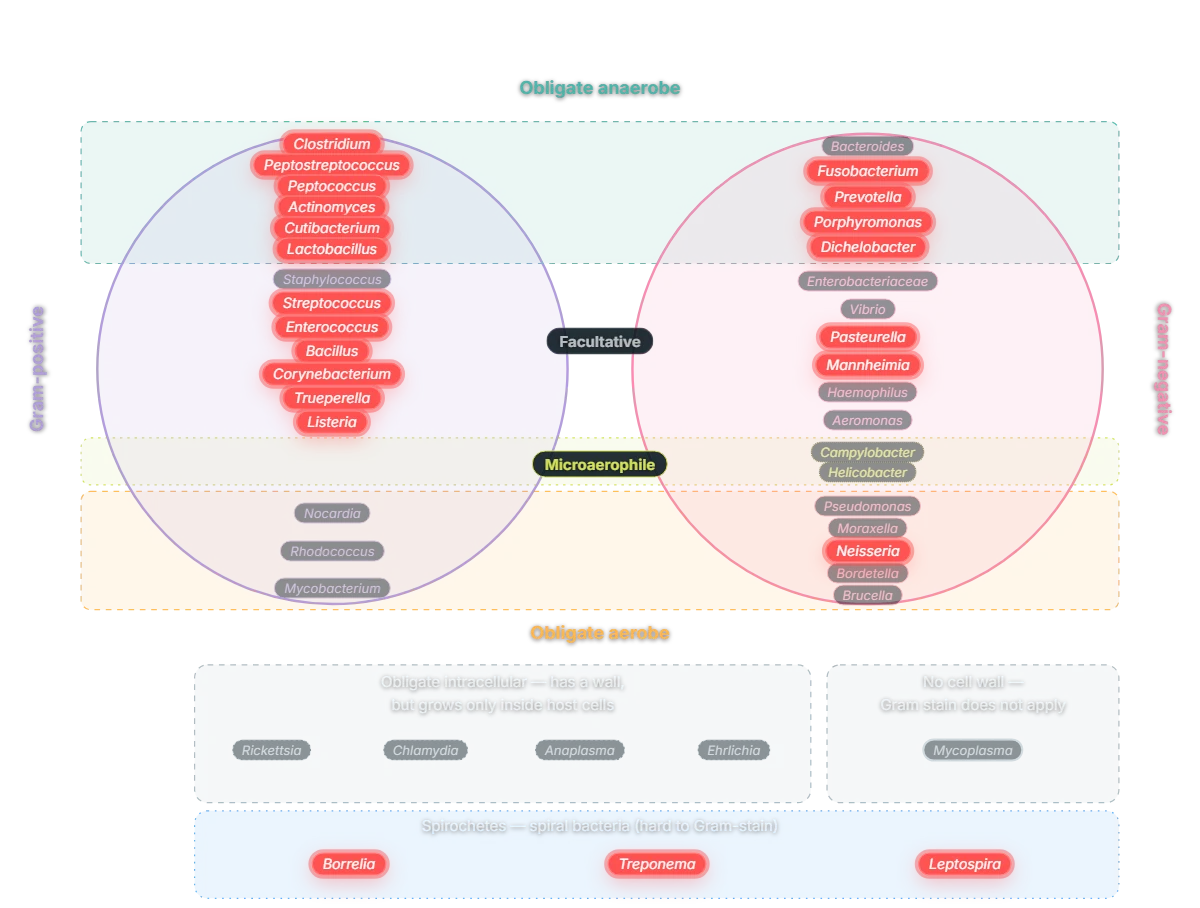
An oral, bactericidal natural penicillin with the same spectrum as penicillin G (natural); it is slightly less active than G in vitro, but its much better oral absorption makes it suitable for mild-to-moderate infections in monogastric animals. It is active against susceptible Gram-positive cocci (streptococci, enterococci), Gram-positive bacilli (Listeria, Clostridium, Actinomyces, Bacillus anthracis), many anaerobes (except Bacteroides fragilis), the Gram-negative coccus Neisseria, Pasteurella, and spirochetes (Leptospira, Borrelia, Treponema). But unlike the aminopenicillins it does not cover the enteric Gram-negatives (E. coli, Klebsiella) or Haemophilus; and because it has no beta-lactamase inhibitor, it is inactive against penicillinase-producing staphylococci (most staph). It also has no effect on Pseudomonas, Mycoplasma, Rickettsia or Mycobacterium.
Open the full-size spectrum image
Veterinary uses and doses
General (susceptible) infection
Dogs & CatsSource: Aronson 1989
5.5–11 mg/kg PO · every 6–8 h
Clinical note: In modern practice, amoxicillin is the preferred oral aminopenicillin (better absorption, less frequent dosing, and broader Gram-negative spectrum); reserve penicillin V for penicillin-susceptible Gram-positive/anaerobic infections (ideally culture-confirmed).
Soft-tissue infection
Dogs & CatsSource: Greene 2006
10 mg/kg PO · every 8 h · 7 days
Dosage forms
Syrup 250 mg/5 mL
Suspension 250 mg/5 mL
Tablet 500 mg
Suspension 125 mg/5 mL
Tablet 250 mg
Safety and clinical notes
Best absorbed on an empty stomach: give at least 1 hour before food or 2 hours after (food reduces the rate and extent of absorption in dogs).
Oral penicillin V is only for mild-to-moderate infections; in sepsis, shock or severe disease do not give an oral antibiotic (GI absorption is impaired) — a parenteral route (preferably IV) is needed.
Its spectrum is like penicillin G (natural) but slightly weaker; inactive against enteric Gram-negatives (E. coli, Klebsiella), Haemophilus and penicillinase-producing staph.
Contraindicated in penicillin allergy; cross-reactivity with cephalosporins and carbapenems is possible.
The most common adverse effects are GI (anorexia, vomiting, diarrhea); it may alter gut flora and cause antibiotic-associated diarrhea.
Never give to rabbits, guinea pigs, chinchillas or hamsters — risk of fatal enteritis (it is safe in dogs and cats).
Do not combine with bacteriostatic antibiotics (chloramphenicol, erythromycin, tetracyclines); penicillins work better on actively dividing bacteria.
Store the reconstituted suspension refrigerated (2–8 °C) and discard after 14 days.
Considered relatively safe in pregnancy (class B).