Species: Dogs & Cats7 dose protocols4 dosage forms
This page is a calculation and educational reference for veterinarians and veterinary students. It does not replace examination, culture and susceptibility testing, clinical judgment, or the attending veterinarian's final decision.
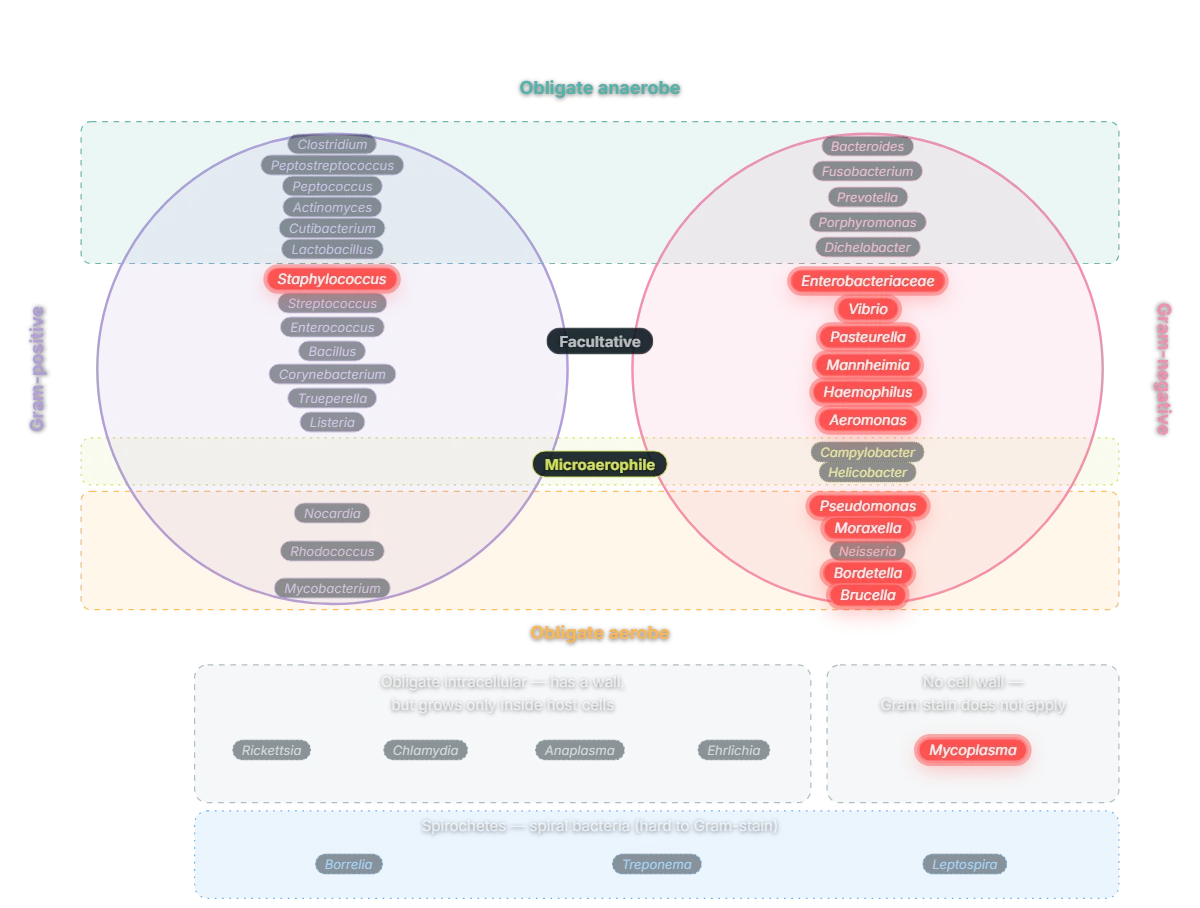
A bactericidal, concentration-dependent aminoglycoside (30S ribosome inhibitor); its strength is aerobic Gram-negative bacilli — Enterobacteriaceae (E. coli, Klebsiella, Proteus, Enterobacter, Serratia, Salmonella, Shigella) and Pseudomonas aeruginosa. It is also active against staphylococci (aerobic Gram-positive cocci), Mycoplasma and Brucella (used for brucellosis, with doxycycline). But it is weak/unreliable against streptococci and enterococci alone (synergises with a beta-lactam), and has no activity against anaerobes. Its activity drops sharply in an acidic/anaerobic environment and inside abscesses (better in an alkaline environment), and it penetrates the CNS and eye poorly. Systemic use is parenteral only. Note: some gentamicin-resistant Pseudomonas, Proteus and Serratia strains may respond to amikacin.
Open the full-size spectrum image
Veterinary uses and doses
Resistant Gram-negative (general/soft tissue)
DogSource: BSAVA 2023 / Plumb's
Susceptible Gram-negative: 10–15 mg/kg · once daily · IV/IM/SC
Clinical note: Aminoglycosides are now given once daily (higher peak = better kill + post-antibiotic effect; lower trough = less renal accumulation); neutropenic/immunocompromised patients may need a divided q8h dose. Keep the course short, keep the animal hydrated, and monitor renal function and urinalysis (urinary casts = an early sign of nephrotoxicity).
Localized / urinary
DogSource: ISCAID / BSAVA 2023
Localized/urinary: 10–15 mg/kg · once daily · 7–10 days
Clinical note: For uncomplicated UTI, amoxicillin/clavulanate (or trimethoprim-sulfa) is first-line; reserve fluoroquinolones and aminoglycosides for complicated/resistant cases, ideally after culture (ISCAID).
CatSource: ISCAID / BSAVA 2023
Localized/urinary (cat): 5–8 mg/kg · once daily · < 7 days
Clinical note: In cats, amoxicillin/clavulanate is first-line for simple bacterial cystitis, and fluoroquinolones and aminoglycosides are reserved for complicated/resistant cases, ideally after culture (ISCAID). Note: in cats most lower-urinary signs are idiopathic (FIC) and non-infectious — confirm bacterial infection by culture before giving an antibiotic.
Sepsis / bacteremia
DogSource: BSAVA 2023 / Hardie 2000
Sepsis/bacteremia: 10–15 mg/kg IV · once daily · < 7 days
Combination therapy: with a beta-lactam (penicillin or cephalosporin) for Gram-positive/anaerobic cover and synergy
Clinical note: Do not mix the aminoglycoside and beta-lactam in the same syringe/line (the aminoglycoside is inactivated) — give them separately. IV must be diluted and infused over at least 30 minutes. Use with great caution and renal monitoring in shock/dehydration and renal impairment.
CatSource: BSAVA 2023 / Hardie 2000
Sepsis/bacteremia (cat): 5–8 mg/kg IV · once daily · < 7 days
Combination therapy: with a beta-lactam (penicillin or cephalosporin) for Gram-positive/anaerobic cover and synergy
Clinical note: Because cats are more sensitive to toxicity, start at the low end (5) and go higher only with serum-level monitoring if possible. Do not mix the aminoglycoside and beta-lactam in the same line; give IV diluted over ≥30 minutes. Use with great caution in dehydration/renal impairment.
Brucellosis
DogSource: Hartmann & Greene 2005
Brucellosis: 5 mg/kg SC · once daily · 7 days (2 courses: weeks 1 & 4)
Combination therapy: with doxycycline (or minocycline) 25 mg/kg PO once daily for 4 weeks; more than one 4-week course may be needed, and serology every 3–6 months is recommended
Clinical note: Monitor renal function throughout gentamicin therapy.
Resistant Gram-negative (general)
CatSource: BSAVA 2023 / Plumb's
Susceptible Gram-negative (cat): 5–8 mg/kg · once daily · IV/IM/SC
Clinical note: Cats are especially sensitive to aminoglycoside toxicity — particularly vestibular signs; start at the low end, give once daily and keep the course short. Keep the animal hydrated and monitor renal function and urine. Neutropenic patients may need q8h dosing.
Dosage forms
Ampoule 80 mg/2 mL
Ampoule 40 mg/1 mL
Ampoule 20 mg/2 mL (pediatric)
Vial 5% (veterinary)
Safety and clinical notes
⚠️ Two main toxicities: nephrotoxicity (tubular necrosis; usually reversible after stopping the drug — gentamicin may be slightly more nephrotoxic than the other aminoglycosides) and ototoxicity (8th-nerve damage; vestibular signs are more common with gentamicin and may be permanent); neuromuscular blockade can also occur.
Toxicity risk factors: preexisting renal disease, very young (neonatal) or geriatric age, fever, sepsis and dehydration. Hydrate the animal and assess renal function before starting.
🐱 Cats are especially sensitive to toxicity (particularly vestibular); use extra caution, a more conservative dose and a shorter course.
For systemic use, once-daily dosing is preferred over divided dosing: both better efficacy (concentration-dependent kill + post-antibiotic effect) and less nephrotoxicity. Exception: neutropenic/immunocompromised patients may need more frequent (q8h) dosing.
Serum-level monitoring (TDM) is recommended for systemic use: the peak should be at least 20 µg/mL and the 4-hour sample below 10 µg/mL. Monitor urine for casts and renal function (BUN/creatinine).
Effective only parenterally (no systemic oral absorption). Give IV diluted in normal saline or 5% dextrose and infused over at least 30 minutes; IM and SC absorption is good (>90%). With training, an owner can give SC injections at home, but monitoring must continue.
No activity against anaerobes, and its activity falls in an abscess/acidic/low-oxygen environment (drain abscesses). It is not reliable against streptococci or enterococci alone — it synergises with a beta-lactam for these.
Do not mix with beta-lactams (penicillins/cephalosporins) in the same syringe/line — the aminoglycoside is inactivated (gentamicin is very susceptible to this); give them separately.
Interactions: loop (furosemide) or osmotic (mannitol) diuretics and other nephrotoxic drugs (amphotericin B, vancomycin, cisplatin, polymyxin) increase toxicity risk; general anesthetics and neuromuscular blockers potentiate neuromuscular blockade (special caution in myasthenia gravis).
Pregnancy class C (crosses the placenta; risk of fetal 8th-nerve or renal damage) — only for serious infection weighing benefit against risk. Use with caution in working dogs (police, search-and-rescue, etc.) that rely on voice commands — it can cause hearing loss/deafness and reduced performance; and in rabbits and rodents. The 100 mg/mL injection is a large-animal product and is not appropriate for dogs and cats.