Species: Dogs & Cats9 dose protocols3 dosage forms
This page is a calculation and educational reference for veterinarians and veterinary students. It does not replace examination, culture and susceptibility testing, clinical judgment, or the attending veterinarian's final decision.
General dose: dog 5–20 mg/kg once daily · cat 5 mg/kg/day ceilingSource: Baytril (general)
Spectrum of activity
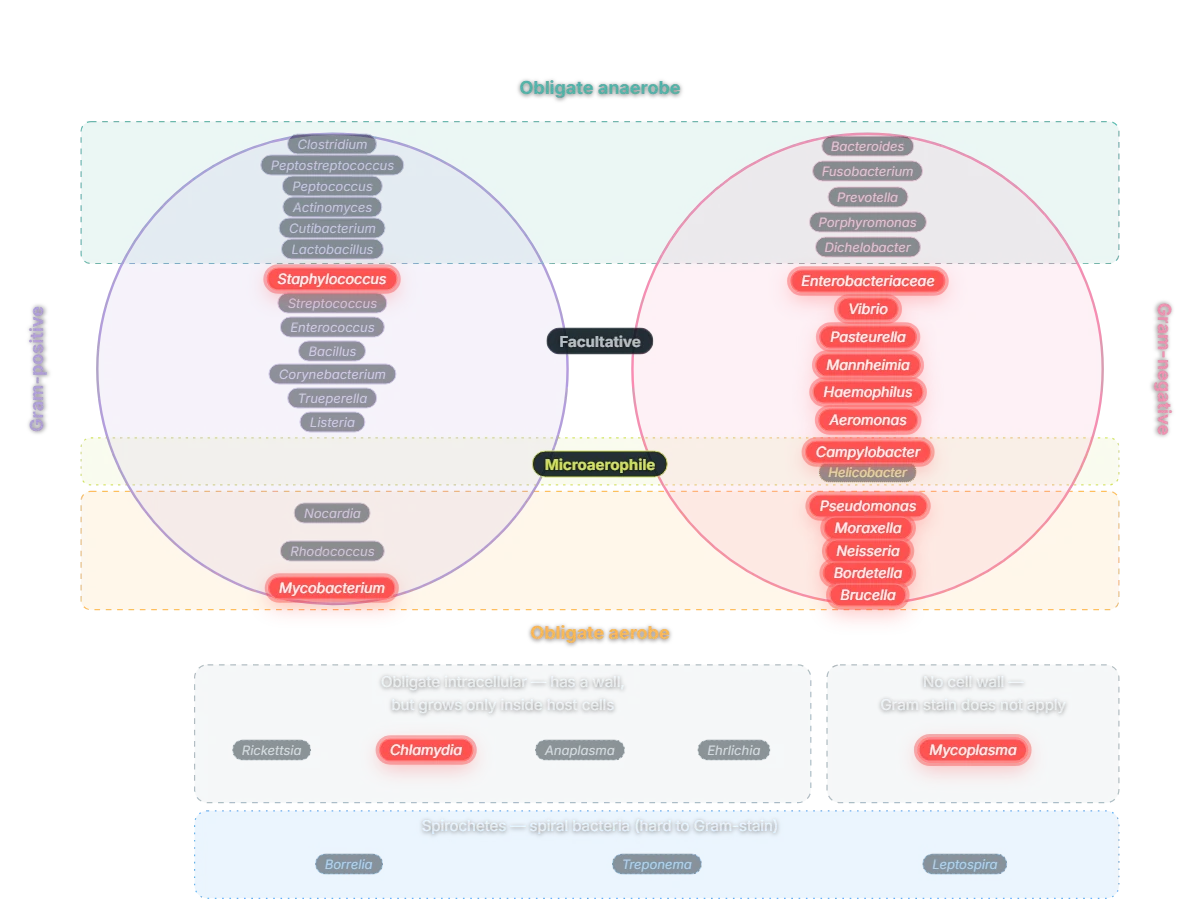
A veterinary fluoroquinolone, concentration-dependent bactericidal (DNA-gyrase inhibitor). It has a strong Gram-negative spectrum: Enterobacteriaceae (E. coli, Klebsiella, Proteus, Salmonella, Enterobacter, Serratia), Pasteurella, Mannheimia, Bordetella, Haemophilus, Campylobacter and Brucella. Activity against Pseudomonas is isolate- and susceptibility-dependent and must not be assumed without culture and AST. It can be active against staphylococci, including penicillinase-producing isolates, but activity is isolate-dependent; MRSA/MRSP must not be assumed susceptible and use requires culture and susceptibility confirmation. It also covers selected atypical/intracellular bacteria (Mycoplasma, Chlamydia). Activity against Mycobacterium is species- and isolate-dependent; mycobacterial disease requires speciation, susceptibility testing and appropriate multidrug therapy rather than enrofloxacin monotherapy. But it has variable/weak activity against streptococci (not a good choice), is inactive against anaerobes, and enterococci are resistant.
Open the full-size spectrum image
Veterinary uses and doses
General
DogSource: Baytril (Bayer)
5–20 mg/kg PO · once daily · max 30 days
CatSource: Baytril (Bayer)
Cat: 5 mg/kg PO · once daily · max 30 days ⚠️ absolute ceiling 5 mg/kg/day
Clinical note: In cats, if a fluoroquinolone is needed, pradofloxacin (Veraflox) is a safer option — it has no retinal toxicity even at several times the dose and covers streptococci/anaerobes better; prefer it if available.
Susceptible skin or urinary infection: 5–10 mg/kg PO · once daily · culture/AST-directed
Clinical note: Enrofloxacin is not first-line for sporadic bacterial cystitis or uncomplicated superficial pyoderma. Use it only when culture and susceptibility testing documents a susceptible isolate and suitable narrower-spectrum first-line options are unavailable. Determine duration from the specific diagnosis, clinical response and scheduled recheck rather than a fixed prolonged course inherited from an older source. The automatic course ceiling is 30 days; continuation or a change in therapy requires clinical reassessment.
Lower respiratory
DogSource: Greene 2006
Lower respiratory: 5–10 mg/kg PO · once daily · 7–14 days (chronic/Mycoplasma longer)
Prostate
DogSource: Greene 2006
Prostatitis: 5–10 mg/kg PO · once daily · 4–6 weeks (chronic)
Histiocytic ulcerative colitis
DogSource: Greene 2006
Histiocytic ulcerative colitis (Boxer): 5–10 mg/kg PO · once daily · at least 8 weeks (culture-guided)
Bone and joint infection
DogSource: Greene 2006
Bone and joint infection requiring systemic therapy: 5–11 mg/kg PO or parenteral · once daily · 10 days (bone infection often requires longer therapy)
Pseudomonas (soft tissue)
DogSource: Greene 2006
High dose: 11–20 mg/kg PO or parenteral · once daily · at least 7 days (confirm by culture)
Sepsis / bacteremia
DogSource: Greene 2006 / Hardie 2000
Bacteremia/sepsis: 5–20 mg/kg PO or parenteral · once daily
Combination therapy: not adequate alone for sepsis (no Gram-positive/anaerobic cover) — give with a beta-lactam (e.g. ampicillin or cefazolin)
Dosage forms
Oral tablet 50 mg
Injectable 5% (50 mg/mL)
Injectable 2.5% (25 mg/mL)
Safety and clinical notes
⚠️ Cat: absolute ceiling 5 mg/kg/day. Higher doses (especially >15 mg/kg) can cause permanent blindness (acute retinal degeneration); monitor for mydriasis and retinal changes and never exceed the ceiling.
Relatively contraindicated in young, growing animals (articular cartilage damage): small/medium dogs from 2–8 months; large/giant breeds may need to wait beyond 8 months.
⚖️ Stewardship: fluoroquinolones are not first-line for uncomplicated UTI; reserve them for complicated/resistant cases and ideally after culture (E. coli resistance is rising). Give the full daily dose once daily (concentration-dependent effect; reduces resistance).
Forms unsuitable for small animals: the 10% (100 mg/mL) injectable is for large animals (diluting/using it in small animals is not recommended); poultry oral solutions are also not for dogs and cats.
Injectable route in dogs: the preferred route is IM (rapid, complete absorption; the product's label route). SC is also common but, because of the high solution pH (~11), it may be painful and irritating (possible sterile abscess). IV only slowly (at least 10 min) and diluted (1:1 to 1:10 with normal saline) — rapid/undiluted injection risks arrhythmia, hypotension, vomiting and histamine release. Injection in cats (even <5 mg/kg) is contraindicated (blindness).
Do not mix or co-administer with magnesium-containing IV fluids (Normosol-R, Plasma-Lyte) — particulate precipitation in the lungs has been reported.
Oral absorption is reduced by cations (antacids, dairy, iron, zinc, sucralfate) — separate by at least 2 hours. Give preferably on an empty stomach (unless it causes vomiting).
Interacts with theophylline/aminophylline: enrofloxacin raises their blood levels and can cause toxicity — if used together, reduce the theophylline dose and monitor.
Use with caution in hepatic/renal impairment and dehydration (risk of crystalluria and drug accumulation); caution in seizure disorders (CNS stimulation). The tablet is very bitter; crushing the coated tablet is not recommended.
Not recommended in pregnancy (cartilage risk) unless the benefit clearly outweighs the risk; safety in the pregnant/lactating cat is not established. (Contraindicated in humans because of CNS effects.)
Cited sources
Baytril (general)
Baytril (Bayer)
ISCAID UTI guideline 2019 / ISCAID canine pyoderma guideline 2025