Aminopenicillin (no beta-lactamase inhibitor) · bactericidal (cell-wall synthesis inhibitor)
Species: Dogs & Cats12 dose protocols8 dosage forms
This page is a calculation and educational reference for veterinarians and veterinary students. It does not replace examination, culture and susceptibility testing, clinical judgment, or the attending veterinarian's final decision.
Drug overview
Aminopenicillin (no beta-lactamase inhibitor) · bactericidal (cell-wall synthesis inhibitor)
Brand names: Polyflex®, Principen®
General dose: 10–20 mg/kg · every 8 hSource: Papich / BSAVA (general)
Spectrum of activity
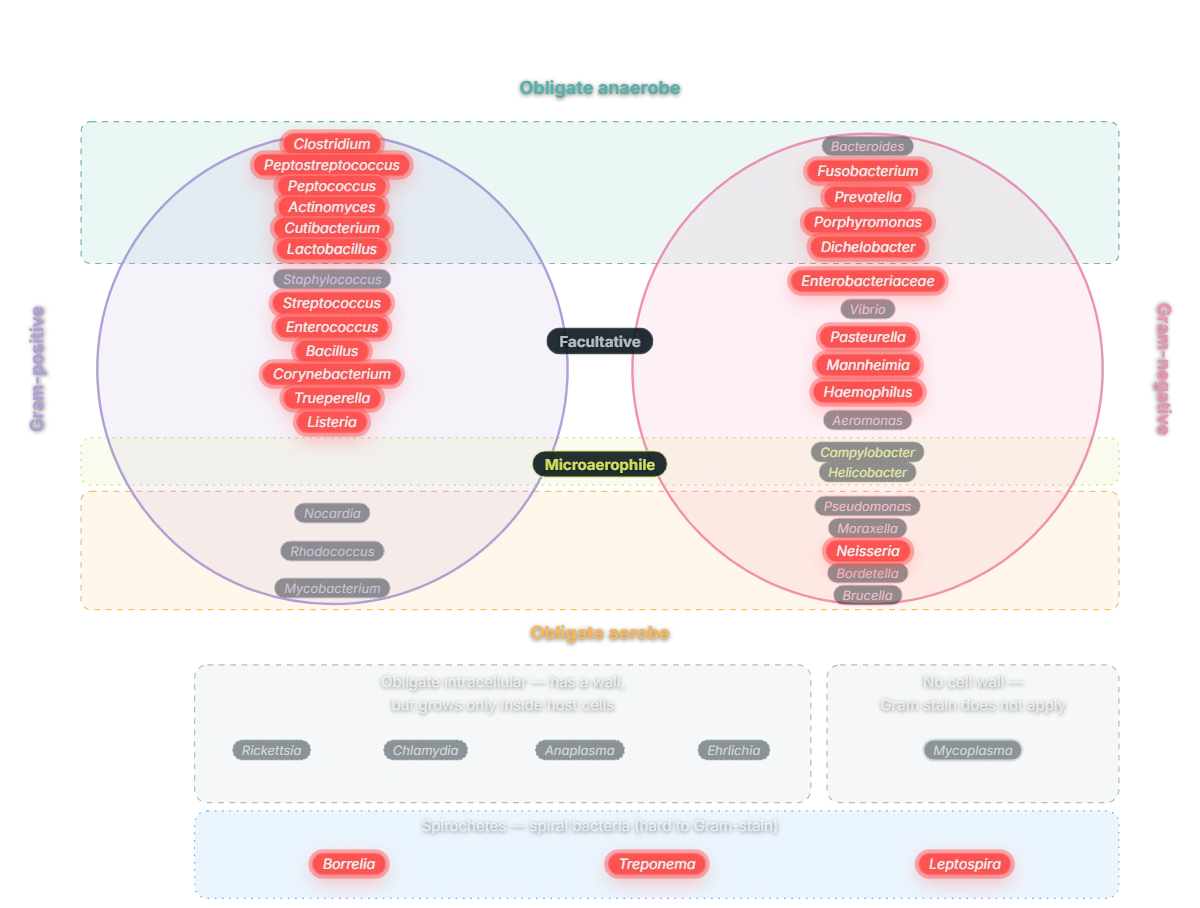
A broad-spectrum, bactericidal aminopenicillin with a spectrum similar to amoxicillin, but without a beta-lactamase inhibitor. It is active against streptococci, enterococci, Listeria, many anaerobes (Clostridium, Fusobacterium), some Gram-negatives (susceptible E. coli, Proteus mirabilis, Pasteurella, Haemophilus) and spirochetes (Leptospira, Borrelia). But because it lacks a beta-lactamase inhibitor, it has no activity against beta-lactamase-producing bacteria — such as most Staphylococcus and Bacteroides fragilis (unlike co-amoxiclav). It also has no effect on Pseudomonas, Enterobacter, Klebsiella or cell-wall-free/intracellular bacteria (Mycoplasma, Rickettsia).
Open the full-size spectrum image
Veterinary uses and doses
Soft tissue
DogSource: Greene 2006
Soft tissue: 10–20 mg/kg · every 8 h · 7 days
CatSource: Papich / BSAVA
Cat: 10–20 mg/kg PO · every 8 h · 7–14 days
Urinary tract infection (UTI)
DogSource: Greene 2006 / Polzin 2005
12.5–25 mg/kg PO · every 8–12 h · 3–7 days
Clinical note: Because ampicillin is poorly absorbed orally, amoxicillin is the preferred oral option for urinary tract infection.
DogSource: Greene 2006
6.6 mg/kg IM or SC · every 12 h · 3–7 days
CatSource: Greene 2006
Cat: 20 mg/kg PO · every 8–12 h · 7–14 days
Pneumonia / systemic
DogSource: Greene 2006
22 mg/kg · every 8 h · 7–14 days
Meningitis / orthopedic
DogSource: Greene 2006
22 mg/kg · every 6–8 h
Sepsis / bacteremia
DogSource: Greene 2006 / Hardie 2000
20–40 mg/kg parenteral · every 6–8 h
DogSource: Greene 2006
Neonatal sepsis: 50 mg/kg IV or IO · every 4–6 h
CatSource: Greene 2006
Cat (systemic): 7–11 mg/kg parenteral · every 8–12 h
20 mg/kg IV · every 6 h (only until doxycycline is tolerated)
Clinical note: Doxycycline 5 mg/kg PO every 12 hours is the drug of choice and eliminates renal carriage. Use IV ampicillin only as initial therapy when vomiting or another adverse effect prevents doxycycline. Start doxycycline as soon as it is tolerated and continue it to complete a 14-day total antimicrobial course. Review dosing in severe renal dysfunction.
Dosage forms
Ampicillin sodium vial 500 mg
Ampicillin sodium vial 250 mg
Ampicillin sodium vial 1000 mg (1 g)
Ampicillin sodium vial 2000 mg (2 g)
Capsule 250 mg
Capsule 500 mg
Suspension 125 mg/5 mL
Suspension 250 mg/5 mL
Safety and clinical notes
Ampicillin has no beta-lactamase inhibitor, so it is inactive against beta-lactamase-producing bacteria (most staphylococci, Bacteroides fragilis) — use co-amoxiclav or ampicillin/sulbactam in those cases.
Oral absorption is poor and is further reduced by food; give the oral form on an empty stomach (1 hour before or 2 hours after food). In practice amoxicillin is the better oral option and ampicillin is used mostly parenterally.
Contraindicated in penicillin allergy; cross-reactivity with cephalosporins and carbapenems is possible.
Never give to rabbits, guinea pigs, chinchillas or hamsters — risk of fatal enteritis and clostridial enterotoxemia (it is safe in dogs and cats).
In septicemia or shock, oral absorption is reduced; use a parenteral route (preferably IV).
The most common adverse effects are GI (anorexia, vomiting, diarrhea); usually more with oral use than amoxicillin.
Use the reconstituted injectable solution within about 1 hour; preferably dilute with normal saline (dextrose accelerates drug hydrolysis). Do not mix with aminoglycosides (amikacin, gentamicin) in one syringe or solution.
The vial salt matters: an ampicillin sodium vial (solution) can be given IV (and IM); but an ampicillin trihydrate vial (a veterinary suspension) is IM or SC only and must not be given IV (it is a suspension and carries an embolism risk).
All injectable vial entries in this calculator represent ampicillin sodium; the prescription displays only protocol routes that overlap IV/IM. Veterinary injectable ampicillin trihydrate suspension is not represented here; it is IM/SC only and must never be given IV.
Considered relatively safe in pregnancy (class A in dogs and cats).