Species: Dogs & Cats11 dose protocols9 dosage forms
This page is a calculation and educational reference for veterinarians and veterinary students. It does not replace examination, culture and susceptibility testing, clinical judgment, or the attending veterinarian's final decision.
General dose: 10–20 mg/kg PO · every 12 hSource: Current veterinary product labels
Spectrum of activity
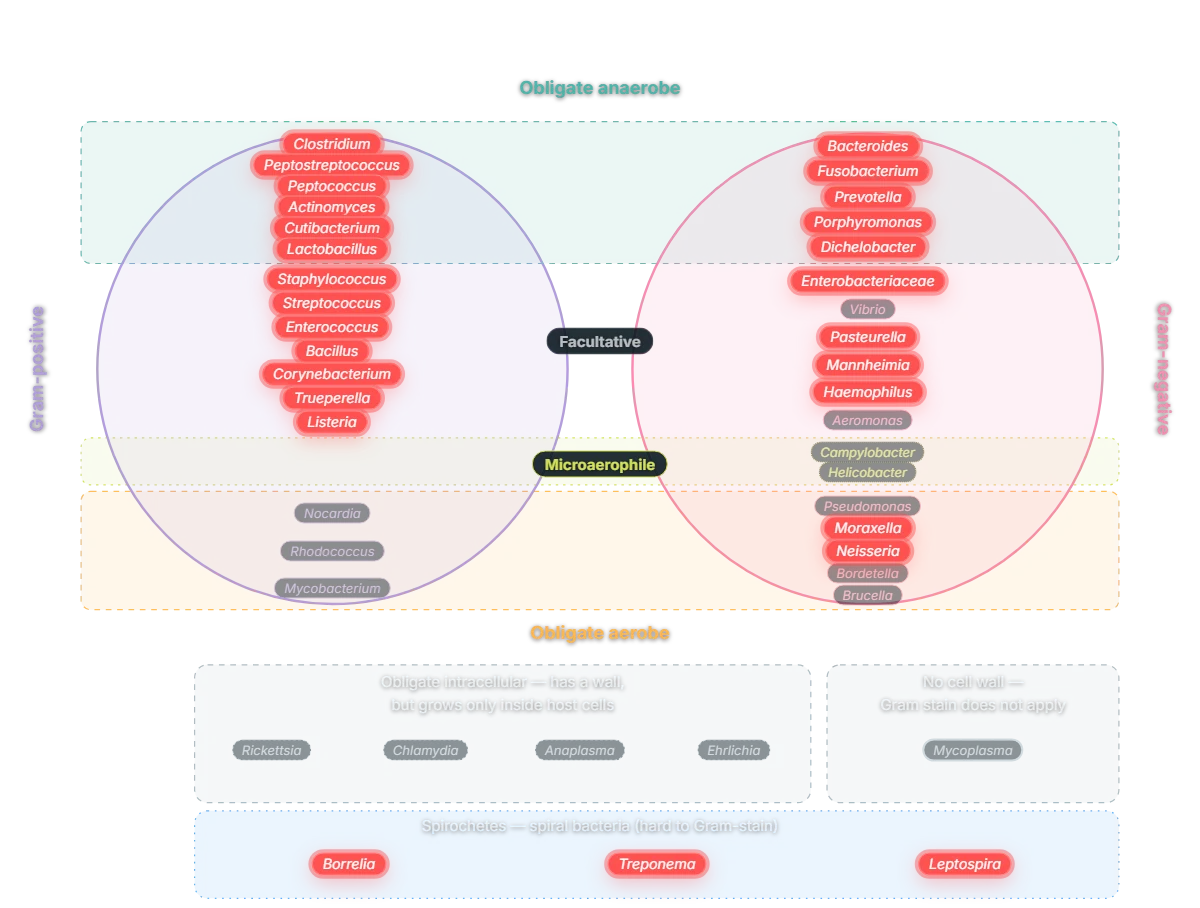
A broad-spectrum, bactericidal aminopenicillin; adding clavulanic acid (a beta-lactamase inhibitor) makes it active against beta-lactamase-positive staphylococci and anaerobes (including Bacteroides). Its spectrum covers Gram-positives (staphylococci, streptococci, enterococci, Listeria, Actinomyces), many Gram-negatives (Pasteurella, E. coli, Proteus, Haemophilus) and spirochetes (Borrelia of Lyme disease, Leptospira). But it has no activity against Pseudomonas, Enterobacter, Serratia and methicillin-resistant staph (MRSA/MRSP); and because its mechanism is cell-wall inhibition, it has no effect on cell-wall-free (Mycoplasma) or intracellular (Rickettsia, Ehrlichia, Chlamydia) bacteria.
Open the full-size spectrum image
Veterinary uses and doses
General (susceptible) infection
DogSource: Plumb's
11 mg/kg · every 12 h
CatSource: Plumb's
Cat: 10 mg/kg · every 12 h
Urinary tract infection (UTI)
DogSource: ISCAID 2019
10 mg/kg · every 12 h · 3–5 days
Clinical note: For sporadic cystitis, plain amoxicillin is first-line (ISCAID 2019); reserve co-amoxiclav for recurrent/complicated infection or beta-lactamase-producing bacteria.
CatSource: ISCAID 2019
Cat: 10–20 mg/kg · every 12 h · 3–5 days
Clinical note: For sporadic cystitis, plain amoxicillin is first-line and co-amoxiclav is reserved for recurrent/complicated or beta-lactamase-positive cases (ISCAID 2019). In cats most lower-urinary signs are idiopathic (FIC) and non-infectious — confirm infection by culture before giving an antibiotic.
Skin & soft tissue
DogSource: Plumb's
Soft tissue/skin: 10 mg/kg · every 12 h · 5–7 days
DogSource: Plumb's
Deep pyoderma: 10 mg/kg · every 12 h · 14–120 days
DogSource: Aucoin 2002
Non-superficial pyoderma: 10–20 mg/kg · every 12 h · 3–6 weeks
Clinical note: Maximum 520 mg of amoxicillin per dose (equivalent to 650 mg of a 4:1 product). If no response by the end of the first week, increase to three times daily; and if there is still no response by the end of the second week, stop treatment.
DogSource: Hillier 2006
Recurrent pyoderma: 11–17.5 mg/kg · every 8–12 h
CatSource: Greene 2006
Cat: 10–20 mg/kg · every 12 h · 5–7 days
Sepsis / bacteremia
DogSource: Plumb's
Bacteremia (oral step-down): 17.5 mg/kg · every 8–12 h · 7 days
Clinical note: ⚠️ Active sepsis/bacteremia requires initial intravenous therapy. Oral co-amoxiclav is not adequate for a septic patient; this dose is only for oral step-down after the patient is stabilized.
CatSource: Greene 2006
Cat — bacteremia/pneumonia (oral step-down): 10–20 mg/kg · every 8 h · 7–10 days
Clinical note: ⚠️ Active sepsis/bacteremia requires initial intravenous therapy. Oral co-amoxiclav is not adequate for a septic patient; this dose is only for oral step-down after the patient is stabilized.
Dosage forms
Suspension 156.25 mg/5 mL (125+31.25)
Suspension 228.5 mg/5 mL (200+28.5)
Suspension 312.5 mg/5 mL (250+62.5)
Suspension 457 mg/5 mL (400+57)
Suspension 642.9 mg/5 mL (600+42.9)
Tablet 62.5 mg (50+12.5)
Tablet 375 mg (250+125)
Tablet 625 mg (500+125)
Tablet 1000 mg (875+125)
Safety and clinical notes
⚠️ Doses and calculated amounts are based on the amoxicillin component; the strength shown in each formulation name is the combined amoxicillin + clavulanate total.
Veterinary reference products generally use a 4:1 amoxicillin:clavulanate ratio. Human formulations use several ratios and are not automatically interchangeable; check both components on the selected product label.
Contraindicated in penicillin allergy; cross-reactivity with cephalosporins and carbapenems is possible.
Never give to rabbits, guinea pigs, chinchillas or hamsters — risk of fatal enteritis and clostridial enterotoxemia (it is safe in dogs and cats).
The most common adverse effects are GI (anorexia, vomiting, diarrhea); giving it with food can help.
In septicemia or shock, oral absorption is reduced; an injectable form is preferred in those cases.
No activity against Pseudomonas, Enterobacter, Serratia and methicillin-resistant staph (MRSA/MRSP), nor against Mycoplasma and intracellular bacteria (Rickettsia, Chlamydia).
The amoxicillin:clavulanate ratio varies among human products; veterinary products for dogs and cats generally use a 4:1 ratio.
Considered relatively safe in pregnancy (class A in dogs and cats).