VetFluid

Antibiotic Therapy

Clindamycin

Lincosamide · active against Gram-positive and anaerobic bacteria

Species: Dogs & Cats21 dose protocols5 dosage forms

This page is a calculation and educational reference for veterinarians and veterinary students. It does not replace examination, culture and susceptibility testing, clinical judgment, or the attending veterinarian's final decision.

Drug overview

Lincosamide · active against Gram-positive and anaerobic bacteria

Brand names: Antirobe®, Cleocin®
General dose: 5.5–11 mg/kg · every 12 h · POSource: Plumb's (general)

Spectrum of activity

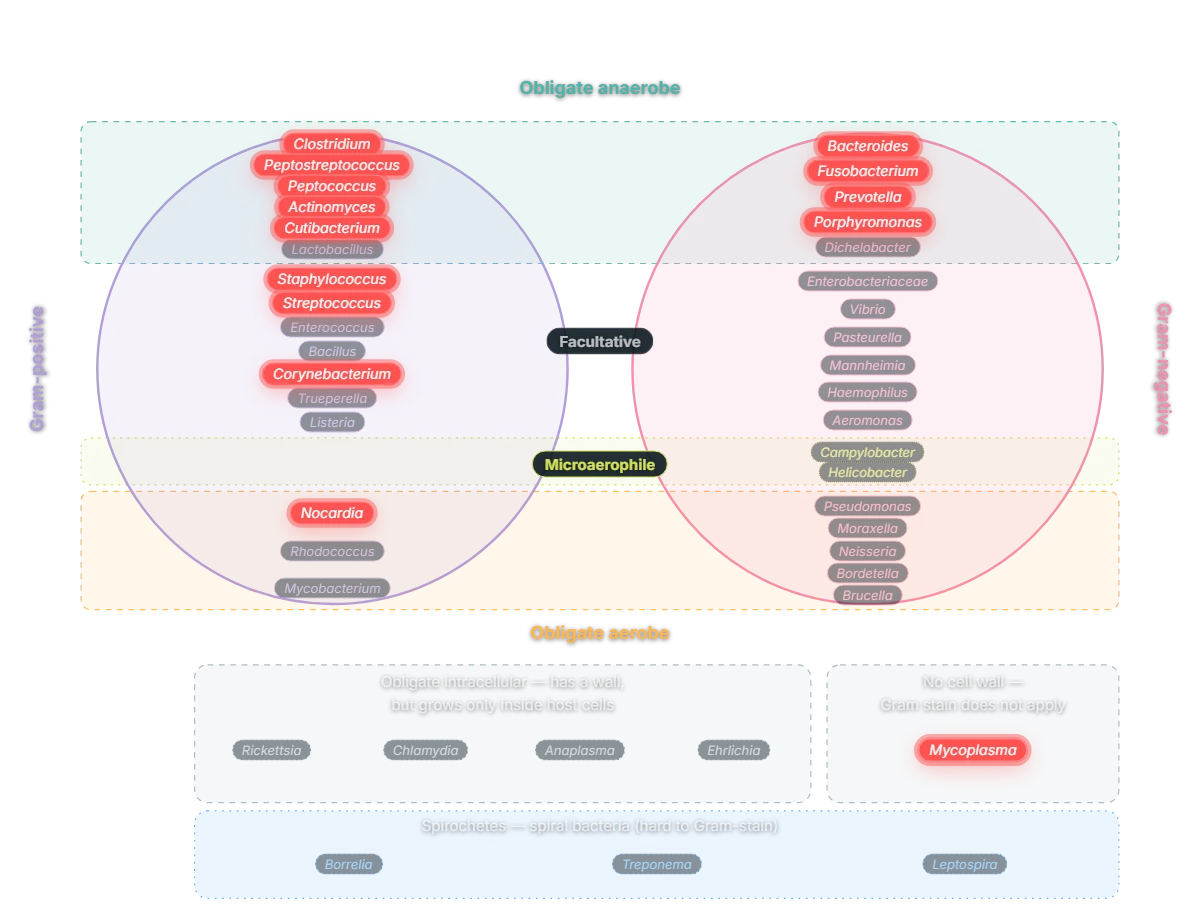
Clindamycin (a lincosamide) is active against aerobic Gram-positive cocci — staphylococci (including penicillinase-producing strains) and streptococci — but is inactive against enterococci (Strep. faecalis). Its main strength is broad anaerobic cover: both Gram-negative anaerobes (Bacteroides including many B. fragilis strains, Fusobacterium, Prevotella, Porphyromonas) and Gram-positive anaerobes (Peptostreptococcus, Peptococcus, Actinomyces, Cutibacterium and Clostridium perfringens/tetani — but not C. difficile). It is also active against Corynebacterium, Nocardia, Mycoplasma and the protozoan Toxoplasma. Unlike metronidazole it also covers the Gram-positive anaerobes above the diaphragm (mouth/respiratory tract) and is a good complement to it. It has no activity against aerobic Gram-negative bacilli (Enterobacteriaceae/E. coli, Pseudomonas, Pasteurella); so it is not suitable alone for Gram-negative infections — such as a bite wound where Pasteurella predominates.
Clindamycin spectrum of activity chart
Open the full-size spectrum image

Veterinary uses and doses

Skin, soft tissue & dental

DogSource: Antirobe (Pfizer) / Greene & Watson 1998

Wound/abscess/dental infection: 5.5–11 mg/kg · every 12 h · 7–28 days

DogSource: ISCAID 2025

Superficial pyoderma (bacterial folliculitis): 11 mg/kg · every 12 h

Clinical note: Per ISCAID (2025) the recommended dose is 11 mg/kg every 12 h; although 5.5 mg/kg every 12 h has also been effective in studies, the higher dose gives a more consistent response. The course is at least 2 weeks, and the patient should be reassessed before its end to decide whether to continue or stop. In recurrent pyoderma, resistance develops quickly.
DogSource: Greene & Watson 1998

Osteomyelitis: 11 mg/kg · every 12 h · up to 28 days

CatSource: Jenkins 1987 / Trepanier 1999

General bacterial: 5–10 mg/kg · every 12 h

CatSource: Antirobe (Pfizer)

Wound/abscess/dental infection: 11–33 mg/kg · once daily · up to 14 days

Clinical note: If no clinical response within 3–4 days, do not continue; the maximum labeled course is 14 days.

Anaerobic & systemic infection

DogSource: Greene & Jang 2006

Anaerobic infection: 5–10 mg/kg · every 12 h

DogSource: Hardie 2000

Sepsis/bacteremia: 11 mg/kg IV · every 12 h

DogSource: Greene 2006

Intra-abdominal infection/pancreatitis: 5–11 mg/kg · every 8–12 h · 3–7 days

Combination therapy: with gentamicin or a 3rd-generation cephalosporin (e.g. cefotaxime) or enrofloxacin — for Gram-negative cover
DogSource: Greene & Reinero 2006

Respiratory infection: 10 mg/kg · every 12 h

Clinical note: Clindamycin does not cover Gram-negative bacilli; in respiratory infection it is mainly used for anaerobic/aspiration or mycoplasmal infections. If a Gram-negative agent is suspected, combine it with suitable cover (e.g. a fluoroquinolone).
DogSource: Center 2006

Hepatobiliary infection: 5–10 mg/kg PO · every 12 h

Clinical note: In hepatic dysfunction: 5 mg/kg PO every 12 h or SC every 24 h.
DogSource: Edwards 2006

Actinomycosis: 5 mg/kg SC · every 12 h

DogSource: Greene & Jang 2006

Surgical prophylaxis (Gram-positive + anaerobic): 5–11 mg/kg PO, 16–60 min before surgery

CatSource: Greene & Jang 2006

Anaerobic infection: 5–10 mg/kg · every 12 h

CatSource: Hardie 2000

Sepsis: 11 mg/kg IV · every 12 h

CatSource: Greene 2006

Intra-abdominal infection/pancreatitis: 5–11 mg/kg · every 8–12 h · 3–7 days

Combination therapy: with gentamicin or a 3rd-generation cephalosporin (e.g. cefotaxime) or enrofloxacin — for Gram-negative cover
CatSource: Greene & Reinero 2006

Respiratory infection: 10–15 mg/kg · every 12 h

Clinical note: Clindamycin does not cover Gram-negative bacilli; in respiratory infection it is mainly used for anaerobic/aspiration or mycoplasmal infections. If a Gram-negative agent is suspected, combine it with suitable cover.
CatSource: Greene & Jang 2006

Surgical prophylaxis: 5–11 mg/kg PO, 16–60 min before surgery

Protozoal

DogSource: Lappin 2004

Toxoplasmosis: 10–12.5 mg/kg · every 12 h · at least 4 weeks

DogSource: MSD/CAPC

Neospora: 12.5–25 mg/kg · every 12 h · 4–8 weeks

Combination therapy: with trimethoprim/sulfa 15–20 mg/kg every 12 h or pyrimethamine 1 mg/kg every 24 h
Clinical note: Start treatment early (even on clinical suspicion, before test results are back); clindamycin acts on tachyzoites, not bradyzoites. With CNS involvement, a course of up to 8 weeks is often needed.
CatSource: ABCD 2024 / Lappin 2004

Clinical toxoplasmosis (drug of choice): 10–12.5 mg/kg · every 12 h · at least 4 weeks

Clinical note: The drug of choice for feline toxoplasmosis. Non-ocular/non-neurologic signs usually improve within 2–3 days (ocular and neurologic forms respond more slowly). In uveitis, add topical prednisolone acetate 3–4 times daily.
CatSource: Lappin / ABCD 2024

Reducing oocyst shedding (reducing zoonotic risk): 10–12.5 mg/kg · every 12 h · 2–4 weeks

Clinical note: The effective dose for reducing shedding is the same as the clinical-treatment dose (10–12.5 mg/kg every 12 h, ~20–25 mg/kg per day); in a study, ~20 mg/kg per day stopped oocyst shedding. Important: oocyst shedding is usually a single, brief event (3–10 days after first infection) and a seropositive cat does not usually shed again; the main way to reduce zoonosis is hygiene and environmental management (daily litter-box changes, processed food, preventing hunting). This treatment is used only in selected cases.

Dosage forms

Safety and clinical notes

Cited sources

  1. Plumb's (general)
  2. Antirobe (Pfizer) / Greene & Watson 1998
  3. ISCAID 2025
  4. Greene & Watson 1998
  5. Greene & Jang 2006
  6. Hardie 2000
  7. Greene 2006
  8. Greene & Reinero 2006
  9. Center 2006
  10. Edwards 2006
  11. Lappin 2004
  12. MSD/CAPC
  13. Jenkins 1987 / Trepanier 1999
  14. Antirobe (Pfizer)
  15. ABCD 2024 / Lappin 2004
  16. Lappin / ABCD 2024
Calculate a weight-based dose

Drug-data last updated: