Species: Dogs & Cats6 dose protocols8 dosage forms
This page is a calculation and educational reference for veterinarians and veterinary students. It does not replace examination, culture and susceptibility testing, clinical judgment, or the attending veterinarian's final decision.
General susceptible infection: 15–30 mg/kg PO q12h · at least 5 daysSource: VMD Cefabactin SPC (2024) / Plumb's monograph
Spectrum of activity
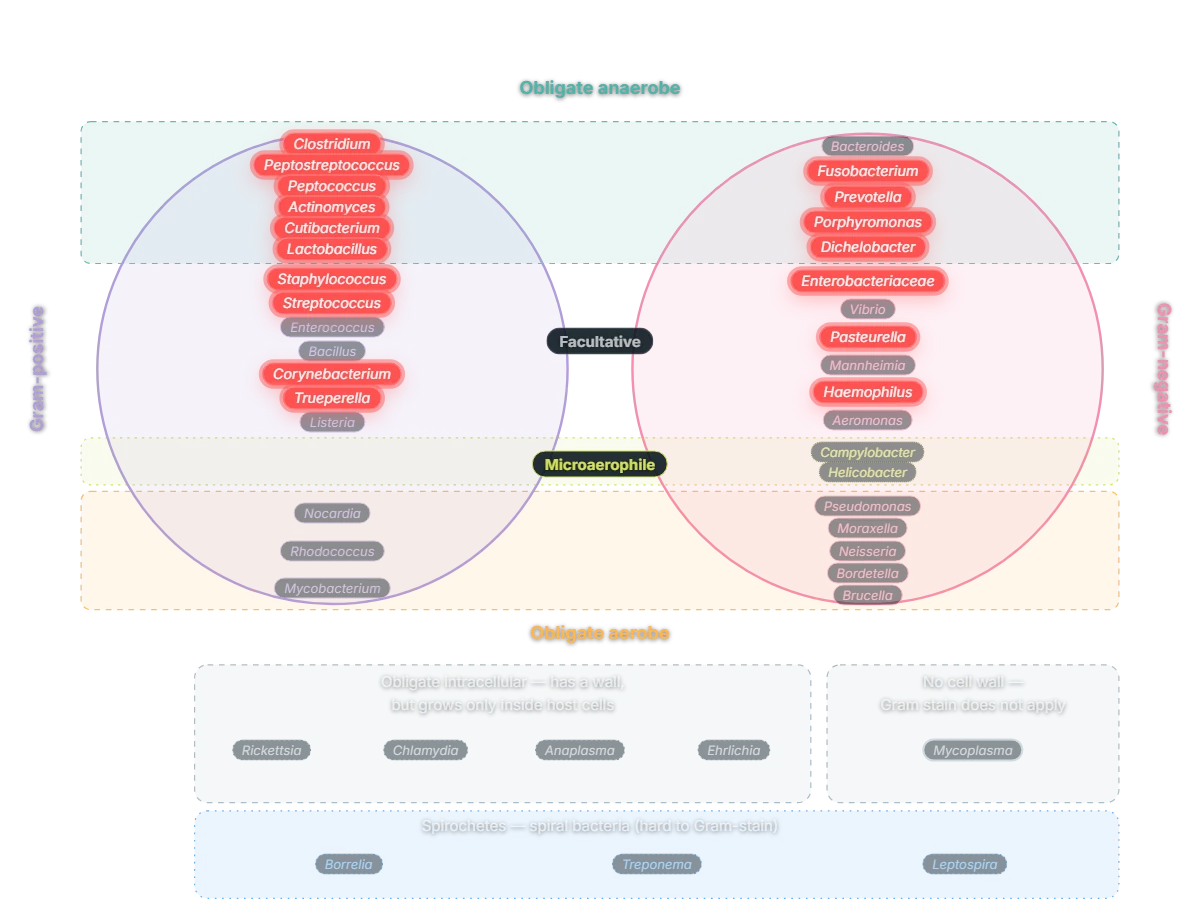
An oral first-generation cephalosporin with time-dependent bactericidal activity and strongest coverage of Gram-positive organisms. It is usually active against streptococci and meticillin-susceptible staphylococci, including Staphylococcus pseudintermedius, and covers many susceptible anaerobes; Bacteroides fragilis is an important exception. Gram-negative activity is limited and susceptibility-dependent, with possible activity against susceptible E. coli, Klebsiella and Proteus mirabilis. Do not rely on cephalexin for enterococci, MRSP/MRSA, Pseudomonas, Enterobacter, Serratia, Citrobacter or indole-positive Proteus. It has no activity against intracellular or cell-wall-free organisms such as Mycoplasma and Rickettsia. For recurrent or deep infection, or recent antimicrobial exposure, select therapy from culture and susceptibility results.
Superficial pyoderma, when systemic therapy is indicated: 22–25 mg/kg PO q12h · initial 14-day course
Clinical note: Topical treatment alone is first choice for superficial pyoderma. Reserve systemic treatment for cases in which topical therapy is ineffective or impractical. Recheck before day 14 and stop once the primary infectious lesions have resolved; routine treatment beyond clinical resolution is not supported.
Deep pyoderma: 22–25 mg/kg PO q12h · initial 21-day course
Clinical note: Culture and susceptibility testing are strongly recommended for deep pyoderma, with adjunctive topical therapy. Recheck before week 3; if infection remains clinically and cytologically evident, continue with 2-weekly reviews. There is no evidence for treatment beyond resolution of infection.
Sporadic bacterial cystitis: 12–25 mg/kg PO q12h × 3–5 days
Clinical note: This regimen is for sporadic bacterial cystitis in a dog or cat, not pyelonephritis, prostatitis or subclinical bacteriuria. Recurrent infection calls for urine culture and investigation of the underlying cause. Enterococci are intrinsically resistant, and Enterobacteriaceae resistance may be common.
Feline skin & subcutaneous infection
CatSource: VMD Therios cat leaflet (2025)
Susceptible wound or abscess: 15 mg/kg PO q12h × 5 days
Clinical note: For wounds or abscesses caused by susceptible organisms, including Pasteurella. Drainage, lavage and source control remain necessary; base treatment on culture whenever possible.
CatSource: VMD Therios cat leaflet (2025)
Pyoderma due to susceptible staphylococci: 15 mg/kg PO q12h · at least 14 days
Clinical note: If response is incomplete, revisit the diagnosis, source control and culture result. Do not extend empirical treatment without reassessment.
Susceptible respiratory infection
Dogs & CatsSource: VMD Cefabactin SPC (2024)
Respiratory infection due to a susceptible organism: 15–30 mg/kg PO q12h · at least 5 days
Clinical note: Use only for a susceptible pathogen, such as selected Staphylococcus, Streptococcus, E. coli or Klebsiella isolates. In severe pneumonia, sepsis or shock, do not depend on oral absorption; choose suitable parenteral therapy.
Dosage forms
Suspension 125 mg/5 mL
Suspension 250 mg/5 mL
Capsule 250 mg
Capsule 500 mg
Veterinary chewable tablet 75 mg
Veterinary chewable tablet 150 mg
Veterinary chewable tablet 300 mg
Veterinary chewable tablet 600 mg
Safety and clinical notes
⛔ Contraindicated with known cephalosporin or other β-lactam hypersensitivity, and with known penicillin/cephalosporin resistance. Anaphylaxis and cross-reactivity can occur.
Do not rely on cephalexin for MRSP/MRSA, enterococci or Pseudomonas. Obtain culture and susceptibility testing for deep or recurrent pyoderma, or when lesions fail to improve within 5–7 days.
This is an oral drug. In septicaemia, shock or severe illness with unreliable GI absorption, use an appropriate parenteral regimen.
Elimination is mainly renal. Reduce the dose or extend the interval in renal impairment; severe renal failure is a contraindication on the feline product label.
Common adverse effects are anorexia, vomiting and diarrhea. A small meal may reduce GI upset, although food can delay absorption.
Concurrent nephrotoxic drugs, particularly aminoglycosides, or some diuretics such as furosemide can increase renal risk. Combine with bacteriostatic antimicrobials only when clinically justified.
Safety during pregnancy and lactation has not been established in dogs or cats; prescribe only after a benefit–risk assessment.
The Therios feline label excludes kittens under 9 weeks and calls for a benefit–risk assessment in cats under 2.5 kg.
Do not use in rabbits, guinea pigs, hamsters, gerbils or other small rodents.
Cephalosporins can cause false-positive urine glucose results with some methods and falsely increased creatinine with the Jaffé reaction; interpret results against the laboratory method.
Cited sources
VMD Cefabactin SPC (2024) / Plumb's monograph
ISCAID canine pyoderma guideline (2025)
ISCAID UTI guideline (2019) / VMD Cefabactin SPC (2024)