Species: Dogs & Cats5 dose protocols5 dosage forms
This page is a calculation and educational reference for veterinarians and veterinary students. It does not replace examination, culture and susceptibility testing, clinical judgment, or the attending veterinarian's final decision.
Dose reference only—not an empiric regimen: 5–10 mg/kg PO · every 12 hSource: Plumb's (general)
Spectrum of activity
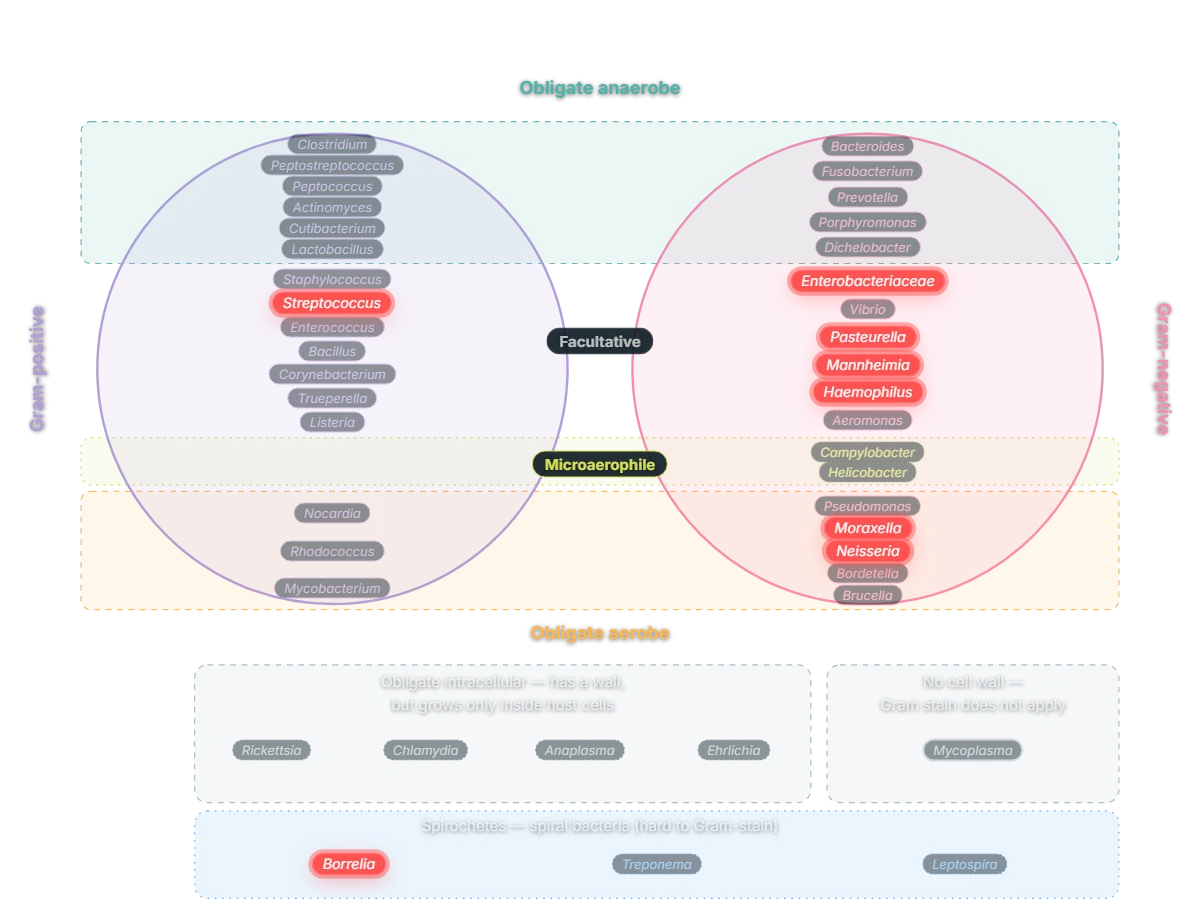
An oral third-generation, bactericidal cephalosporin with a mainly Gram-negative, relatively narrow spectrum. Its strength is Enterobacteriaceae (E. coli, Proteus, Klebsiella) plus Haemophilus and Neisseria; among Gram-positives it mainly covers streptococci, and it is also active against the spirochete Borrelia. But unlike many cephalosporins it is weak against staphylococci, and inactive against enterococci, Listeria, Pseudomonas, Enterobacter, anaerobes (Bacteroides, Clostridium, Actinomyces) and intracellular/cell-wall-free bacteria (Mycoplasma, Rickettsia). ⚠️ E. coli resistance to cefixime is rising.
Open the full-size spectrum image
Veterinary uses and doses
Culture-directed sporadic bacterial cystitis
DogSource: Greene 2006 / ISCAID UTI guideline 2019
5 mg/kg PO · once to twice daily · 3–5 days
Clinical note: Cefixime is a third-generation cephalosporin and is not first-line for sporadic bacterial cystitis. Select it only when urine culture and susceptibility testing confirm a susceptible isolate and amoxicillin (with or without clavulanate) and trimethoprim-sulfonamide are unsuitable based on susceptibility results or patient factors. If an appropriate clinical response is not evident within 48 hours, reassess the diagnosis and predisposing factors.
Respiratory / systemic
DogSource: Greene / Plumb's
5–10 mg/kg PO · every 12 h · 7–14 days
Clinical note: ⚠️ Cefixime is weak against staphylococci and inactive against anaerobes and Mycoplasma; it is not a good single-agent choice for empiric respiratory infection (pneumonia). Its best use is respiratory infection due to a proven susceptible Gram-negative (culture/susceptibility); for Gram-positive/anaerobic coverage it must be combined with a suitable drug.
Infective endocarditis
DogSource: DeFrancesco 2000
10 mg/kg PO · every 12 h
Clinical note: ⚠️ Active endocarditis needs aggressive IV bactericidal therapy; oral cefixime (a 3rd-gen cephalosporin) does not achieve sustained concentrations on the vegetation and is not adequate alone for active endocarditis — consider it only as oral step-down, or as an alternative when fluoroquinolones and aminoglycosides are resisted/contraindicated.
General (susceptible) infection
DogSource: Boothe 1999
5 mg/kg PO · once to twice daily
CatSource: Lappin 2002
Cat: 5–10 mg/kg PO · every 12 h
Dosage forms
Suspension 100 mg/5 mL
Capsule 200 mg
Capsule 400 mg
Tablet 200 mg
Tablet 400 mg
Safety and clinical notes
⚠️ Reserve-drug quick reference: the general dose is a calculation reference, not an empiric treatment regimen. Select cefixime only for a defined indication and a susceptible isolate confirmed by culture and susceptibility testing when appropriate first-line options are unsuitable.
Narrow spectrum: mainly for susceptible Gram-negative infections (such as E. coli in UTI) when other oral options are unsuitable.
Weak against staphylococci and inactive against enterococci, Listeria, Pseudomonas and anaerobes; choose a suitable drug for those.
⚠️ E. coli resistance to cefixime is rising; confirm by culture/susceptibility where possible.
Contraindicated in cephalosporin allergy; cross-reactivity with penicillins is possible.
Dose adjustment is needed in renal impairment.
The most common adverse effects are GI (diarrhea, vomiting, anorexia).
Can be given with or without food. Discard the reconstituted suspension after 14 days (refrigeration not required).
Considered relatively safe in pregnancy (class B).